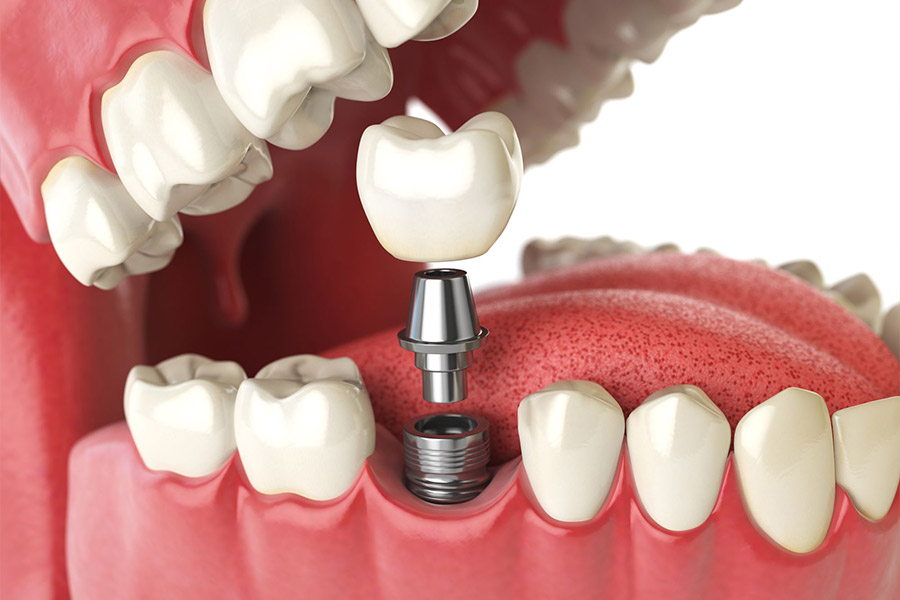
When is implant placement necessary?

Dental implants are an ideal solution for patients who have lost one or more teeth due to: cavities or gum disease, tooth injury and trauma, periodontal disease, long-term wearing of ill-fitting dentures.

Implants not only restore the functionality of the jaw, but also prevent further bone decay, which often happens when the entire tooth or tooth root is missing.

What does the process look like?

The installation of dental implants consists of several precisely planned steps:

  1. First consultation and planning
    Our experts analyze the condition of your teeth, gums, and jaw using state-of-the-art diagnostic equipment, including digital orthopantograms and 3D scanners. Based on these, we create an individual treatment plan.

  2. Installation of implants
    The implant, made of high-quality titanium, is surgically placed into the jawbone. This procedure is painless thanks to local anesthesia and a minimally invasive technique.

  3. Fusion period (osseointegration)
    After placement, the implant fuses with the bone over a period of several months, providing a solid foundation for a future crown or bridge.

  4. Placing the prosthetic part
    After completed osseointegration, a metal-ceramic or zirconium crown is placed on the implant, which is completely adapted to the color and shape of your natural teeth.

We represent several implant systems with great success

All implant systems are of exceptional quality. The decision to set up is determined depending on the indication. Our broad experience has shown certain advantages of certain systems according to the position and structure of the bone.

  • Astra Tech ® (Sweden, USA)
  • Zimmer ® (USA)
  • AlphaBio ® (Israel)
  • ICX ® (Germany, Switzerland)

Frequently Asked Questions

Indications for implantation and removal of wisdom teeth are in no way related to each other, so if the wisdom teeth are healthy and in the correct position, there is no need to touch them before installing the implant. But if wisdom teeth still need to be removed, this can be combined with implantation as part of the same operation under sedation.

Dental implantation does not involve any interventions on areas of neighboring teeth (in fact, this is one of its main advantages), therefore, with a correctly performed operation, there should not be any pain in other teeth. At least we at the Sirius Dent Medical Center have never encountered such cases.

After dental implantation, the swelling may increase until the third day, and after that it decreases. On the seventh day, the swelling finally subsides, and after a control examination, the stitches are removed. If we are talking about a patient who cannot stay in Odesa for a week, he will be given stitches that dissolve by themselves and do not need to be removed.

Before installing a permanent crown, you should brush your teeth in the area of ​​implantation with the utmost care. Once the crown is in place, there are no longer any restrictions on cleaning. And let us remind you that an implant, like any engineering structure, needs care and periodic professional hygiene. Then it will serve you for the rest of your life.

Unlike natural teeth, dental implants are not susceptible to dental disease such as decay; however, the health of the gums is vital to maintaining lasting implant success. Conscientious home care by the patient and regular professional cleanings and check-ups are essential elements for dental implant sustainability. Each patient is different, and success relies upon diagnosis and planning, medical history, and a variety of other factors.